Introduction
Choosing the right stream after Class 10 is one of the most important decisions in a student’s academic life. At this stage, many students feel confused, pressured, or unsure about their future. The Arts stream is often misunderstood, yet it offers some of the most diverse and meaningful career opportunities.
The Arts stream mainly focuses on humanities and social sciences. It helps students understand society, culture, history, politics, economics, and human behavior. Students who enjoy reading, writing, creative thinking, discussion, and analyzing real-world issues usually find Arts a suitable and rewarding choice.
Choosing Arts after 10th does not mean limited growth or fewer opportunities. Instead, it means selecting a stream that builds strong communication skills, critical thinking, and a broad understanding of the world. In India, the Arts stream opens doors to careers in government services, education, law, media, social work, design, and many emerging professional fields.
There are several common myths related to the Arts stream, such as “Arts has no scope” or “Only weak students choose Arts.” These beliefs are outdated and incorrect. With the right subject combination, skills, and career planning, Arts students can achieve good salaries, social respect, and long-term career growth.
This article will help you clearly understand what the Arts stream is, its career options, salary potential, and future scope, so you can make an informed decision after Class 10.
Who Should Choose Arts Stream?
The Arts stream is best suited for students who are curious about society, people, ideas, and real-world issues. It is ideal for those who enjoy reading, writing, discussing topics, and understanding how the world works rather than focusing only on calculations or technical subjects.
Students who have strong interests in subjects like History, Political Science, Geography, Economics, Psychology, Sociology, or Languages often perform well in the Arts stream. It is also a good choice for learners who like creative thinking, problem-solving, communication, and expressing their thoughts clearly through writing or speaking.
Arts is a skill-oriented stream where interest matters more than marks alone. Students with good analytical skills, imagination, empathy, and observation abilities can build successful careers through Arts. It allows learners to explore multiple career paths and choose their direction gradually, instead of being locked into a single technical field early.
Compared to Science or Commerce, the Arts stream generally involves less academic pressure and fewer rigid subject combinations. This makes it suitable for students who want a balanced study life, time for self-development, and the freedom to prepare for competitive exams, creative careers, or professional skills alongside their studies.
Subjects in Arts Stream (Class 11 & 12)
The Arts stream offers a wide range of subjects that focus on humanities, social sciences, creativity, and skill development. In Class 11 and 12, students can choose a combination of core and optional subjects based on their interests and future career goals.
Core Subjects
These subjects form the foundation of the Arts stream and are commonly offered in most schools:
- History
Focuses on ancient, medieval, and modern history, helping students understand past events, civilizations, and their impact on the present world. - Political Science
Covers political theories, constitutions, governance systems, international relations, and the functioning of democracy. - Geography
Includes physical geography, human geography, environmental studies, and map-based learning, linking natural and human systems. - Economics
Introduces basic economic concepts, microeconomics, macroeconomics, national income, development, and financial awareness. - Languages (English / Hindi / Regional Languages)
Strengthens reading, writing, communication, and analytical skills, which are essential for almost every career.
Optional / Elective Subjects
These subjects allow students to specialize or explore specific interests alongside core subjects:
- Psychology
Studies human behavior, mental processes, emotions, and personality development. Useful for careers in counseling, HR, and social work. - Sociology
Focuses on society, social relationships, culture, and social change. Helpful for research, civil services, and social sector careers. - Fine Arts
Includes drawing, painting, sculpture, or applied arts. Suitable for creative careers like design, animation, and visual arts. - Physical Education
Covers sports, fitness, health education, and sports science. Ideal for students interested in sports, fitness training, or teaching. - Computer Science / Mathematics (where available)
Offered in some schools to provide technical or analytical support, useful for data-related fields, economics, or interdisciplinary careers.
Best Subject Combinations (Career Wise)
Choosing the right subject combination is important for future career planning. Some common career-oriented combinations include:
- Civil Services / Government Exams
History + Political Science + Geography + Economics + Language - Law / Legal Studies
Political Science + History + Sociology + Language - Journalism / Media / Content Writing
Language + Political Science + Sociology + Psychology - Psychology / Counseling / HR
Psychology + Sociology + Economics + Language - Design / Creative Careers
Fine Arts + Language + Psychology / Sociology - Economics / Management / Policy Studies
Economics + Mathematics / Computer + Political Science
Students should always choose subjects based on their interests, strengths, and long-term goals rather than following peer pressure or common myths.
Major Career Options After Arts Stream
The Arts stream offers a wide range of career opportunities in both government and private sectors. With the right education, skills, and preparation, Arts students can build stable, respected, and well-paying careers. Below are some of the major and most popular career paths after choosing Arts.
Government Job Careers
Government jobs are among the most preferred career options for Arts students due to job security, social respect, and long-term benefits.
- UPSC / State Public Service Commissions (PSC)
Arts students are well-suited for civil services exams such as administrative, police, and revenue services. Subjects like History, Political Science, Geography, and Economics directly match the exam syllabus, giving Arts students a strong advantage. - SSC / Banking / Railways
Exams conducted by staff selection bodies, banks, and railways offer clerical, officer, and administrative roles. Arts graduates perform well due to their strong general knowledge, reasoning ability, and language skills. - Why Arts Students Perform Well in Government Exams
Arts education builds a deep understanding of society, governance, and current affairs. Strong reading, writing, and analytical skills help Arts students score well in descriptive papers, interviews, and personality tests.
Law & Legal Careers
Law is a highly respected and financially rewarding career option for Arts students.
- LLB (Bachelor of Laws)
After completing Class 12, students can pursue a 5-year integrated law course or a 3-year LLB after graduation. Arts background helps in understanding legal concepts, political systems, and social issues. - Advocate / Judiciary
After LLB, students can practice as advocates in courts or prepare for judicial services exams to become judges. This field offers professional independence, respect, and long-term career growth. - Corporate Law
Corporate lawyers work with companies on contracts, compliance, mergers, and legal advisory roles. This area offers high salary potential, especially in law firms and multinational companies.
Teaching & Education Field
Teaching is a stable and meaningful career option for Arts students who enjoy learning and sharing knowledge.
- School Teacher
Arts graduates can become teachers after completing teacher training programs and required qualifications. Teaching offers job stability and a balanced work life. - Lecturer / Professor
With postgraduate degrees and research qualifications, Arts students can teach at colleges and universities. This career focuses on academics, research, and subject specialization. - Online Education
Digital learning platforms have created new opportunities such as online tutors, course creators, educators, and academic content developers. This field allows flexible work and global reach.
Media, Journalism & Mass Communication Careers
Media and mass communication is a popular and fast-growing career field for Arts students who have strong communication skills, creativity, and interest in current affairs. This field offers opportunities in print, television, radio, and digital platforms, both in India and internationally.
- Journalist
Journalists collect, analyze, and present news related to politics, society, business, sports, and global events. Arts students perform well in journalism because of their strong reading habits, writing skills, and understanding of social and political issues. Journalism careers can be built in newspapers, news channels, magazines, and online news platforms. - Content Writer
Content writers create articles, blogs, website content, scripts, and educational material. With the growth of digital platforms, content writing has become a high-demand skill. Arts students with good language skills and creativity can work as freelance writers, full-time professionals, or global remote workers. - Digital Media Careers
Digital media includes social media management, digital journalism, video content creation, podcasting, and online marketing content. This field offers fast career growth, flexible work options, and opportunities to work with brands, startups, media houses, and international clients. - Anchor / Reporting
Anchors and reporters present news, conduct interviews, and report live from the field. Confidence, clear communication, and strong subject knowledge are key skills in this career. Arts students often excel in reporting roles due to their awareness of current affairs and ability to communicate effectively with diverse audiences.
Creative & Design Careers
Creative and design careers are ideal for Arts students who have imagination, visual thinking, and an interest in creativity and aesthetics. With the growth of digital platforms, advertising, media, and online businesses, design-related careers offer strong income potential and global opportunities.
- Graphic Design
Graphic designers create visual content such as logos, posters, social media graphics, advertisements, and website designs. This career focuses on creativity, layout, color theory, and software skills. Graphic designers are in demand across marketing agencies, companies, startups, and freelance platforms. - Fashion / Interior Design
Fashion designers work with clothing, accessories, and style concepts, while interior designers plan and design indoor spaces such as homes, offices, and commercial buildings. Both careers require creativity, trend awareness, and design sense. Arts students with Fine Arts or design interests often succeed in these fields. - Animation & Multimedia
Animation and multimedia careers include 2D/3D animation, video editing, motion graphics, visual effects, and digital storytelling. This field is widely used in films, gaming, advertising, education, and online content creation. It offers exciting career paths for creative and tech-interested Arts students. - Freelancing Scope
One of the biggest advantages of creative careers is freelancing. Designers and multimedia professionals can work independently, take global projects, and earn income based on skills rather than degrees. Freelancing offers flexible working hours, remote work options, and unlimited growth potential with experience.
Corporate, HR & NGO Careers
Arts students can build successful careers in the corporate sector, human resource management, and non-profit organizations. Strong communication skills, understanding of human behavior, and social awareness make Arts graduates valuable in these fields.
- HR Executive
Human Resource (HR) executives handle recruitment, employee management, training, and workplace policies. Arts students, especially those with backgrounds in Psychology, Sociology, or Management, perform well in HR roles because they understand people, communication, and organizational behavior. - Public Relations (PR)
Public relations professionals manage the public image of companies, brands, and individuals. Their work includes media communication, press releases, event management, and brand reputation building. Arts students with strong language and interpersonal skills are well-suited for PR careers. - CSR & NGO Roles
Corporate Social Responsibility (CSR) and NGO careers focus on social development, education, health, environment, and community welfare. Arts graduates can work as project coordinators, program managers, researchers, or field officers. These roles offer purpose-driven careers with growing opportunities and professional stability. - Corporate Communication
Corporate communication professionals handle internal and external communication, including newsletters, reports, presentations, and official messaging. Arts students with strong writing, presentation, and analytical skills can build long-term careers in this field across large organizations and multinational companies.
Humanities & Social Science Careers
Humanities and social science careers focus on understanding human behavior, society, public systems, and social change. These careers are suitable for Arts students who enjoy research, analysis, writing, and working on real-world social, psychological, and policy-related issues.
Psychology Careers
Psychology careers revolve around understanding human behavior, emotions, mental health, and decision-making. Arts students who study Psychology can work in areas such as counseling, human resources, mental health support, education, and research. With higher education and professional training, careers are available in counseling centers, hospitals, schools, corporate organizations, and wellness platforms. This field offers both social impact and long-term career growth.
Sociology & Social Research
Sociology focuses on society, social structures, culture, and social problems. Careers in this field include social researcher, social analyst, community development professional, and academic roles. Arts students with Sociology backgrounds often work with research organizations, universities, NGOs, government projects, and international agencies. These careers are ideal for students interested in social change, data collection, fieldwork, and policy evaluation.
Policy, Research & Think Tanks
Policy and research careers involve analyzing social, economic, and political issues to support decision-making and development planning. Arts students can work as policy analysts, research associates, or fellows in think tanks, research institutes, and advisory organizations. These roles require strong analytical skills, writing ability, and understanding of public systems. This career path is well-suited for students aiming to influence governance, public policy, and long-term national or global development.
Language-Based Careers After Arts
Language-based careers offer strong opportunities for Arts students who have a passion for languages, communication, and cross-cultural interaction. With globalization and digital communication, language experts are in demand across education, business, media, and international organizations.
Translator & Interpreter
Translators and interpreters work with written and spoken languages to convert content from one language to another accurately. Translators usually handle documents, books, websites, and subtitles, while interpreters work in real-time settings such as meetings, conferences, and legal or medical environments. Arts students with strong language skills can work with media houses, publishing companies, courts, embassies, and international clients.
Foreign Language Expert
Foreign language experts specialize in languages such as French, German, Spanish, Japanese, Chinese, or other global languages. These professionals are employed in multinational companies, tourism, airlines, embassies, international trade, and global customer support. This career path offers high demand, competitive salaries, and opportunities to work abroad or with international organizations.
Publishing & Global Communication
Publishing and global communication careers focus on content creation, editing, proofreading, and international communication management. Arts students can work as editors, language reviewers, content managers, or communication specialists for publishing houses, digital platforms, and global companies. These roles require strong writing, cultural awareness, and communication skills and offer long-term career stability.
Professional Courses After 12th Arts
After completing Class 12 with Arts stream, students can choose from a wide range of professional and academic courses based on their interests and career goals. These courses help build subject expertise, practical skills, and long-term career stability.
- BA (General / Honours)
Bachelor of Arts (BA) is one of the most popular choices after 12th Arts. Students can opt for a general BA or specialize in subjects like History, Political Science, Economics, Psychology, Sociology, or Languages through an honours program. BA provides a strong foundation for careers in education, government exams, research, and higher studies. - LLB (Law)
Arts students can pursue a 5-year integrated law course after Class 12 or a 3-year LLB after graduation. A background in Arts is helpful for understanding legal systems, social issues, and political structures. Law offers careers in advocacy, judiciary, corporate law, and legal advisory roles. - BJMC (Journalism & Mass Communication)
Bachelor of Journalism and Mass Communication (BJMC) prepares students for careers in media, journalism, digital content, public relations, and broadcasting. This course focuses on communication skills, media ethics, reporting, and digital platforms. - BFA / Design Courses
Bachelor of Fine Arts (BFA) and design courses focus on creativity, visual arts, fashion, animation, interior design, and applied arts. These programs are ideal for students with artistic talent and interest in creative industries. - Hotel Management / Tourism
Courses in hotel management and tourism prepare students for careers in hospitality, travel management, airlines, and tourism services. These fields offer global job opportunities and skill-based career growth. - Psychology / Social Work
Degrees in Psychology or Social Work focus on mental health, counseling, community development, and social welfare. These courses are suitable for students who want to work in helping professions, NGOs, healthcare support, or social research.
Salary After Arts Stream (Realistic View)
Salary after choosing the Arts stream depends on multiple factors such as education level, skills, career field, experience, and location. Arts does not offer instant high salaries in most cases, but it provides strong long-term growth, stability, and high-paying opportunities with the right planning.
Entry-Level Salary
At the entry level, Arts graduates usually start with modest salaries. Freshers working in fields like content writing, teaching assistance, HR support, media, NGOs, or administrative roles can expect beginner-level pay.
Entry-level salaries are generally suitable for gaining experience, building skills, and understanding the industry. At this stage, learning and exposure matter more than income. Many Arts students also prepare for competitive exams or higher studies during this phase.
Mid-Level Salary
With 3–7 years of experience, Arts professionals see noticeable salary growth. At the mid-level, careers in HR, journalism, corporate communication, teaching, design, digital media, psychology support roles, and public relations offer stable and respectable income.
Skill development, specialization, certifications, and professional networking play a major role in salary improvement at this stage. Many Arts professionals achieve financial stability and leadership roles during mid-career years.
High-Paying Careers in Arts
Arts stream also offers several high-paying career paths for students who plan strategically and invest in long-term growth. These careers usually require higher education, strong skills, or competitive exam success.
High-paying Arts careers include:
- Civil Services and senior government roles
- Corporate law and legal advisory
- Senior HR managers and corporate communication heads
- Policy analysts and research professionals
- Experienced designers, media professionals, and digital consultants
- International language experts and global communication specialists
In Arts, income grows steadily with experience, reputation, and expertise. Students who focus on skills, higher education, and career planning can achieve excellent salary levels and professional respect over time.
Foreign Job & International Opportunities
The Arts stream offers several international career opportunities for students who are willing to build the right skills, qualifications, and global exposure. With strong communication abilities, cultural understanding, and subject knowledge, Arts graduates can work or study abroad across multiple fields.
- Teaching Abroad
Arts graduates can teach languages, social sciences, or specialized subjects in foreign countries after completing required teaching qualifications. Opportunities are available in international schools, language institutes, and online global education platforms. Teaching abroad offers stable income, cultural exposure, and professional growth. - NGOs & International Bodies
Many international organizations, development agencies, and non-profit institutions hire Arts graduates for roles in education, social development, policy support, research, and community projects. These roles focus on social impact and global development and often involve working across different countries and cultures. - Language & Content Jobs
Language experts and content professionals are in demand globally. Careers include translators, editors, content writers, communication specialists, and digital content managers. Arts students with strong language skills can work remotely for international clients or relocate for global roles. - Higher Studies Abroad
Arts students can pursue higher education abroad in fields such as humanities, social sciences, international relations, public policy, psychology, design, and education. Studying abroad improves career prospects, global networking, and access to international job markets.
Career Growth, Promotion & Stability
Career growth and stability in the Arts stream depend on long-term planning, skill development, and professional experience. While growth may appear slower at the beginning, Arts careers often provide strong stability, respect, and sustainable progress over time.
- Long-Term Growth
Arts careers focus on gradual and steady growth. With experience, specialization, and continuous learning, professionals move into senior roles, leadership positions, or expert profiles. Fields like government services, education, law, research, corporate communication, and media offer long-term career development rather than short-term gains. - Promotion Structure
Promotion in Arts-related careers is usually based on experience, performance, qualifications, and responsibility level. In government jobs, promotions follow a structured system with clear timelines. In corporate, media, education, and NGO sectors, growth depends on skills, results, and professional contributions. - Social Value & Respect
Arts professionals often work in roles that directly impact society, such as teaching, administration, law, journalism, policy-making, and social development. These careers offer strong social value, public trust, and long-term respect. Over time, Arts professionals gain recognition for their knowledge, leadership, and contribution to society.
Common Myths About Arts Stream
The Arts stream is often surrounded by misunderstandings and outdated beliefs. These myths create unnecessary fear and confusion among students and parents. Let’s look at some common myths and the actual reality behind them.
- “Arts Has No Scope” ❌
This is one of the most common myths. In reality, Arts offers a wide range of career options in government services, law, education, media, corporate roles, research, design, NGOs, and international organizations. The scope of Arts depends on subject choice, skills, and career planning. - “Arts Has Low Salary” ❌
Salary in any stream depends on experience, expertise, and career field. While Arts careers may start with moderate pay, many roles offer strong long-term income growth. Civil services, law, corporate communication, policy research, media leadership, and global language careers provide high salary potential. - “Only Weak Students Choose Arts” ❌
This belief is completely incorrect. Arts requires strong reading, writing, analytical thinking, and understanding of complex social and political issues. Many competitive exams and leadership roles are dominated by Arts students due to their broad knowledge and communication skills. - Reality Check ✔
Arts is a stream for students who think deeply, communicate clearly, and understand society. With the right mindset, skills, and planning, Arts students can achieve professional success, financial stability, and social respect. The stream is not weak—wrong guidance and lack of planning are the real problems.
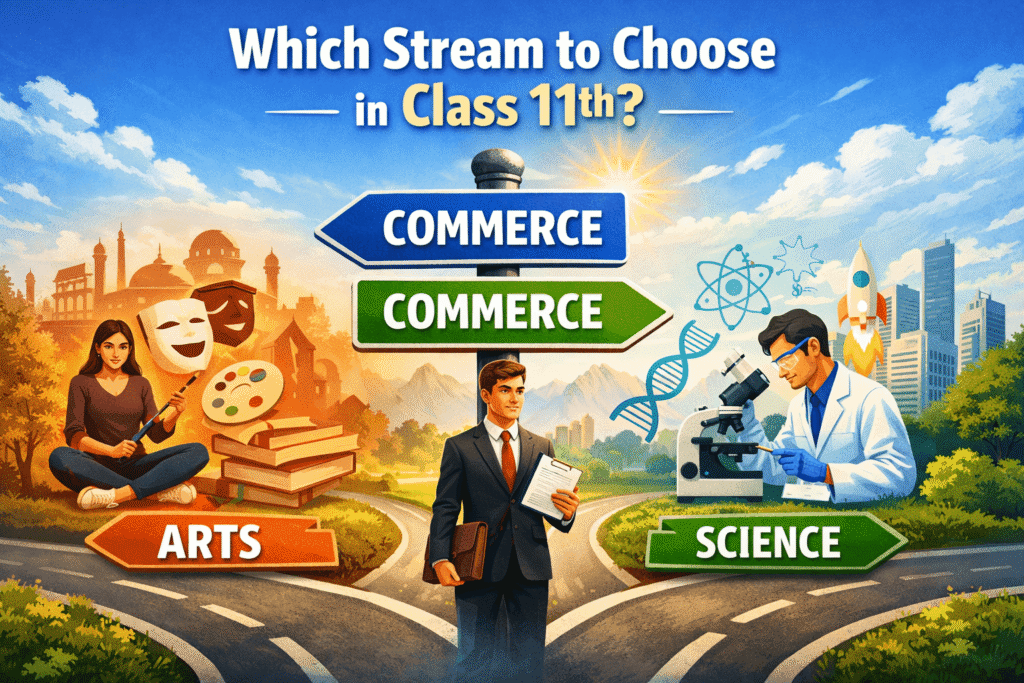
Arts vs Science vs Commerce (Comparison)
Choosing the right stream after Class 10 requires understanding how Arts, Science, and Commerce differ in terms of career options, academic pressure, and long-term stability. Each stream has its own strengths, and the best choice depends on a student’s interests, abilities, and career goals.
Career Flexibility
The Arts stream offers the highest career flexibility. Students can move into government services, law, education, media, design, research, NGOs, corporate roles, and international careers. Subject combinations allow multiple career directions even after graduation.
Science offers moderate flexibility but is more specialized. Career paths are usually fixed early, such as engineering, medical, or pure science fields. Changing direction later can be difficult without additional study.
Commerce provides good flexibility within business-related fields such as accounting, finance, management, banking, and entrepreneurship. However, options are more limited outside commerce-focused careers.
Pressure Level
Arts generally has a lower academic pressure compared to Science and Commerce. It focuses more on understanding, writing, and analysis rather than constant numerical or technical practice. This allows students time for self-study, competitive exam preparation, and skill development.
Science has the highest pressure due to complex concepts, regular practicals, competitive exams, and performance-based evaluation. It demands consistent high-level academic effort.
Commerce has moderate pressure, especially for students pursuing professional courses. Subjects like accounting and economics require regular practice and accuracy.
Government Job Scope
Arts has the strongest alignment with government job exams. Subjects like History, Political Science, Geography, Economics, and Sociology directly match the syllabus of civil services and other competitive exams.
Science students also appear in government exams, but many technical roles require specific degrees. Commerce students mainly enter banking, finance, and administrative roles.
Overall, Arts students often have an advantage in descriptive papers, interviews, and general studies-based exams.
Long-Term Stability
Arts careers offer strong long-term stability through government services, teaching, law, research, and policy-related roles. Growth may be gradual, but stability, respect, and sustainability are high.
Science careers can offer high income and prestige, especially in technical fields, but stability depends on specialization, industry demand, and continuous skill upgrades.
Commerce careers provide good stability in finance, management, and business roles, particularly for professionals with certifications and experience.
In summary, Arts is ideal for students seeking flexibility, balanced pressure, strong government job scope, and long-term stability. Science suits students inclined toward technical and scientific careers, while Commerce is best for business and finance-oriented learners.
How to Choose the Right Career After Arts
Choosing the right career after the Arts stream requires clarity about interests, skills, and long-term goals. Instead of following trends or peer pressure, students should focus on informed and practical decision-making.
- Interest Mapping
The first step is to understand personal interests. Students should identify subjects they enjoy studying, activities they naturally perform well in, and topics they like reading or talking about. Choosing a career aligned with genuine interest increases motivation, learning ability, and long-term success. - Degree + Skill Combination
A degree alone is not enough in today’s competitive world. Arts students should combine academic qualifications with practical skills such as writing, communication, digital tools, research methods, data analysis, or design skills. This combination improves employability and career growth. - Competitive Exam Planning
Students aiming for government jobs or professional roles should plan competitive exams early. Selecting subjects that match exam syllabi, building strong general knowledge, and maintaining consistency in preparation provide a major advantage. Arts students benefit greatly from early and focused exam planning. - Practical Advice
Students should explore internships, volunteering, part-time work, or online projects to gain real-world exposure. Speaking with professionals, attending workshops, and continuously upgrading skills helps in making informed career decisions. Flexibility, patience, and long-term planning are key to success after Arts.
FAQs – Arts Stream After 10th
Is it possible to get a government job after choosing Arts?
Yes, government jobs are one of the strongest career paths for Arts students. Many competitive exams are based on subjects like History, Political Science, Geography, and Economics, which are part of the Arts stream. With proper preparation, Arts students can succeed in civil services, administrative roles, education, and other government sectors.
What is the highest salary career in the Arts stream?
There is no single highest salary career, as income depends on skills, experience, and specialization. However, careers such as civil services, corporate law, senior media roles, policy research, international communication, and senior HR or corporate communication positions offer high earning potential over time.
Are foreign job opportunities available after Arts?
Yes, Arts students can work abroad in fields like teaching, international NGOs, content and communication roles, language-based jobs, and research. Higher studies abroad also open doors to global career opportunities, provided students build strong academic and skill profiles.
Which is better: Arts or Commerce?
Neither stream is better or worse. Arts is suitable for students interested in humanities, communication, social sciences, and government exams, while Commerce is better for students inclined toward business, finance, and accounting. The right choice depends on individual interest, skills, and career goals.
Final Guidance for Students & Parents
Choosing the right stream after Class 10 is an important life decision, and it should be based on understanding, not fear or social pressure. The Arts stream is not a weak option—it is a meaningful and powerful path for students who have interest in humanities, communication, creativity, and understanding society.
For students, the key is to choose Arts with clarity and commitment. Success in Arts depends on interest, consistent effort, skill development, and long-term planning. When combined with the right subjects, professional courses, and practical experience, Arts can lead to stable, respected, and well-paying careers in India and abroad.
For parents, it is important to support a child’s interest rather than comparing streams. Every student has different strengths, and Arts offers wide career flexibility, strong government job opportunities, and long-term stability. With proper guidance, Arts students can achieve professional success, social respect, and personal satisfaction.
In conclusion, Arts is the right choice for students who want flexibility, balanced academic pressure, meaningful careers, and long-term growth. With the right mindset and guidance, the Arts stream can open doors to a bright and successful future.
Still confused after Class 10? Explore our detailed guides on Science and Commerce streams to make the right career decision.